AI Product Updates Daily — June 3, 2026
ChatGPT crosses 1 billion monthly active users as OpenAI's ads go live in the UK and Codex expands to six white-collar job roles. Microsoft closes Build 2026 with seven new MAI models, Rayfin BaaS, Fabric IQ, and Windows for agents. Anthropic scales Mythos and Project Glasswing to 150 critical infrastructure orgs across 15 countries. NVIDIA Cosmos 3 ships as a physical AI data factory for robotics. Google's Gemini CLI shuts down June 18, and Snowflake launches Cortex Training and Apache Iceberg v3 GA at Summit 2026.
A packed 48-hour window: Microsoft closes out Build 2026 with seven new in-house AI models, ChatGPT quietly crosses 1 billion monthly users while its ads roll into the UK, Anthropic expands Mythos access to critical infrastructure across 15 countries, and NVIDIA's Cosmos 3 reframes what physical AI can mean for robotics. Meanwhile Google begins counting down to the Gemini CLI shutdown, and OpenAI's Codex has moved well past coding into selling equity and running data analytics.
OpenAI
ChatGPT hits 1 billion monthly active users
ChatGPT reached 1 billion global monthly active app users in May — the fastest any app has crossed that milestone, outpacing TikTok, Instagram, YouTube, and Google Maps, according to Sensor Tower estimates reported by Reuters. The user base grew 62% year-over-year, though Claude's 640% YoY MAU growth is closing the gap: U.S. users who installed Claude in Q1 2026 spent 5% less time on ChatGPT one month after installation. 1
Codex expands to six white-collar job roles
OpenAI released six role-specific plug-ins for Codex covering data analytics, creative production, sales, product design, equity investing, and investment banking. Each bundles integrations, pre-loaded instructions, and job context so the tool works out of the box without per-user configuration. The company also released a Sites feature that outputs Codex work as hosted interactive websites — partnering with Wix, Base44, Replit, Lovable, Figma, and Emergent at launch — and an Annotations feature for referencing specific parts of documents in context operations. Codex now has more than 5 million weekly active users; knowledge workers represent about 20% of that base and are growing more than three times as fast as developers. 2
ChatGPT ads launch in the UK, delivery issues persist
OpenAI's job posting for a Regional Sales Manager, Ads Solutions EMEA confirmed that ChatGPT ads will launch in the UK "in early June," with ongoing EMEA expansion to follow. 3 The ads currently run on Free and Go tier accounts in the US, Canada, Australia, and New Zealand; Plus, Pro, and all Business plan subscribers see no ads. Formats include advertiser name, favicon, headline, copy, landing page URL, and image asset. CPM campaigns default to $60 CPM; CPC campaigns start at a recommended $3–5 per click. 4
Behind the expansion headlines, ad delivery is still under-performing. Some advertisers who committed up to $250,000 in early pilot spending used less than a tenth of that budget. Fill rates have improved 30–50% since launch but remain short of full inventory, and basic performance reporting remains limited. OpenAI reduced minimum ad commitments from $250,000 to $50,000 and later dropped the floor entirely with the self-serve Ads Manager launch. OpenAI has no plans to share ad revenue with publishers, per its VP of media partnerships. 5
Anthropic
Mythos and Project Glasswing expand to 150 organizations across 15+ countries
Anthropic expanded Project Glasswing — its AI-powered critical security vulnerability program — from roughly 50 initial U.S.-focused partners to about 150 new organizations across more than 15 countries, including Australia, Canada, France, Germany, Italy, Switzerland, Netherlands, Spain, Belgium, Sweden, India, Japan, New Zealand, and South Korea. New sectors now included: power, water, healthcare, communications, and hardware — industries underrepresented in the initial cohort. Named organizations receiving access include Okta, Samsung, SK Hynix, SK Telecom, NATO, and the EU's cybersecurity agency ENISA, per Financial Times reporting. Anthropic estimates that a successful cyberattack on most of these organizations could affect more than 100 million people. 6
Separately, Palo Alto Networks reported fiscal Q3 revenue of $3 billion (up 31% YoY), with CEO Nikesh Arora crediting Anthropic's Mythos model with boosting demand for cybersecurity services — specifically noting that Mythos expanded the company's Project Glasswing program. Non-GAAP EPS came in at $0.85 versus $0.80 expected. 7
Microsoft
Build 2026: seven new MAI models, Rayfin, Fabric IQ, Azure HorizonDB, and Windows for agents
Microsoft's Build developer conference (June 2–3, San Francisco) delivered a cluster of announcements aimed at positioning the company as an end-to-end agentic AI platform.
Seven new MAI models shipped at Build:
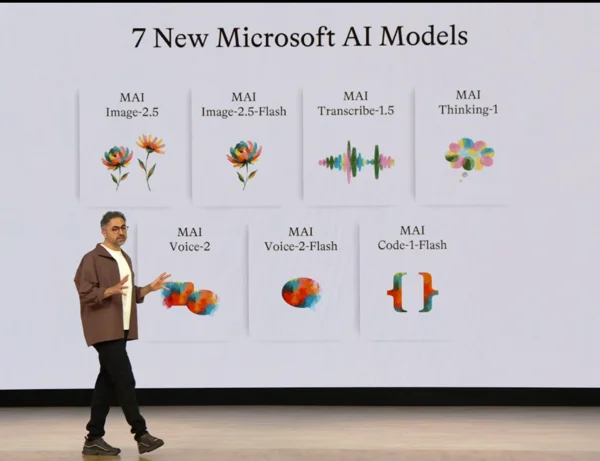
- MAI-Thinking-1 — Microsoft AI's flagship reasoning model. Mid-sized (35B active parameters), trained entirely on clean curated data with no third-party model distillation. In software engineering benchmarks it matches leading models; in blind human evaluation it outperforms Sonnet 4.6. Available on Azure Foundry and through Baseten (early access), OpenRouter, and Fireworks. Weight-level customization is available for the first time.
- MAI-Code-1-Flash — 5B-parameter coding model optimized for GitHub Copilot, VS Code, and the Microsoft stack. Performance comparable to Haiku at lower cost.
- MAI-Image-2.5 (plus a Flash variant) — supports text-to-image generation and image editing; Arena scores above Nano Banana Pro.
- MAI-Transcribe-1.5 — speech transcription at 5× the speed of leading competitors, with SOTA accuracy and native support for domain-specific terminology in 43 languages.
- MAI-Voice-2 — high-quality voice synthesis in 15 languages with short-sample voice adaptation; abuse safeguards built in. A MAI-Voice-2-Flash variant is coming.
Platform announcements:
- Rayfin — open-source SDK and CLI for a managed backend-as-a-service (BaaS) for building agentic apps on Microsoft Fabric. Handles identity management, database auth, storage, messaging, observability, and GitHub integration without teams needing to build their own infrastructure.
- Fabric IQ — Microsoft's enterprise context layer, connecting data in OneLake (unified enterprise data estate), semantic business intelligence models, and real-time operational signals into a coherent foundation for agents. Connects to Work IQ (emails, docs, Teams) via APIs and MCP; Foundry IQ for knowledge bases and runbooks tied to 10,000+ models; Grounding Enhancements in preview combining internal and external context.
- Azure HorizonDB — Postgres-compatible enterprise database optimized for AI applications. Now in public preview in Central US, Sweden Central, West US 2, and West US 3, with more regions in coming weeks.
- Windows 365 for Agents — GA. Cloud PCs that let AI agents execute multi-step workflows on Windows infrastructure. Microsoft is positioning Windows as the primary local environment for building, testing, and running AI agents.
- Surface RTX Spark Dev Box — compact developer PC with an NVIDIA RTX Spark superchip, designed for on-device AI agent workloads.
- GitHub Copilot desktop app — Preview. Native desktop experience with isolated per-task workspaces, support for concurrent sessions, built-in automations for personal workflows.
- Work IQ APIs — GA on June 16. Standard interface for agents to interact with Microsoft 365 context (emails, documents, presentations, Teams transcripts). 9
NVIDIA
Cosmos 3 ships as a physical AI data factory
NVIDIA launched Cosmos 3 at GTC Taipei. The model is a world foundation model — not a creative video generator — built specifically to help teams build, train, and evaluate robots, autonomous systems, and vision AI agents. 10
The Cosmos 3 family includes:
- Cosmos 3 Nano — efficient deployment, real-time workloads, single H100
- Cosmos 3 Super — maximum reasoning capability and generation quality
The unified omni-model architecture exposes six interaction modes through one API:
text2image, text2video, image2video, forward_dynamics (predict next scene state), inverse_dynamics (recover actions from video), and policy (generate robot action sequences). The practical value for robotics labs is in the last three — particularly using inverse_dynamics on unlabeled video corpora (YouTube footage, factory cameras, dashcam data) to generate labeled training data at scale, bypassing the need for expensive teleoperation rigs.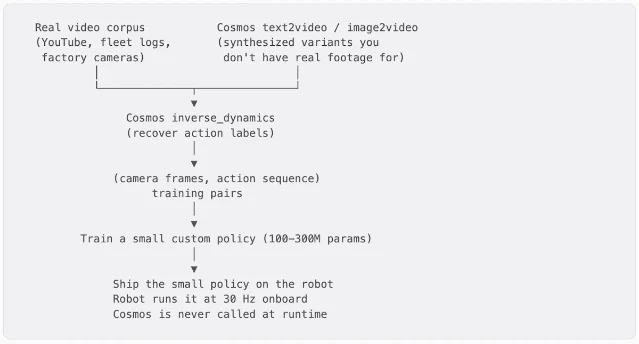
Cosmos 3 Nano is deployable today via Baseten; Cosmos 3 Super requires contacting Baseten directly. 11
Gemini CLI shutting down June 18; replacement is Antigravity CLI (closed source)
Google confirmed that Gemini CLI will stop serving requests for all non-enterprise users on June 18, 2026. The tool had accumulated 100,000+ GitHub stars and received more than 6,000 external contributor pull requests before the shutdown. The replacement, Antigravity CLI, is written in Go (single binary), is closed-source, and uses proprietary licensing. Non-enterprise users must migrate; enterprise Gemini Code Assist Standard and Enterprise licensees retain access indefinitely. 12
The migration path: install Antigravity CLI (
agy), import existing Gemini plugins via agy plugin import gemini, rename GEMINI.md to AGENTS.md, and update any CI/CD scripts referencing gemini to use agy. The two tools can coexist on the same machine during the transition window. The key friction point developers have raised: Google accepted contributions to an open-source Apache 2.0 project, then shifted to a closed-source replacement and removed access for the contributors who built it.MAI-Thinking-1 on Baseten
Baseten and Microsoft AI announced a partnership to host MAI-Thinking-1 on Baseten infrastructure. Beyond standard API access, Baseten customers will be able to fine-tune MAI-Thinking-1 weights — an option not available through most closed-model providers, where fine-tuned checkpoints remain on the lab's infrastructure. Microsoft has no visibility into customers' fine-tuning data, feedback signals, or domain adaptations. MAI-Thinking-1 is currently in early access; interested teams can apply via Baseten's model library. 13
Snowflake
Summit 2026: Cortex Training, Apache Iceberg v3 GA, CoWork updates
At Snowflake Summit 2026 (San Francisco), Snowflake announced:
- Apache Iceberg v3 support is generally available — full support for the latest open table format within Snowflake Storage, enabling read/write across Snowflake and external data estates.
- Cortex Training — new capability in the Cortex AI portfolio for model customization and training, extending Snowflake CoCo (formerly Cortex Code) beyond inference into fine-tuning.
- CoWork updates including Cortex Sense (real-time signals), Artifacts, Deep Research, User Skills, and personalization features for interacting with enterprise data and AI agents.
- Horizon Catalog — a context layer across the data estate for governance and AI grounding.
Q2 2026 tool changes: Sora gone, ChatGPT pricing restructured, Perplexity limits tightened
A recap of the AI stack changes that took effect in Q2, relevant to teams now doing stack reviews:
- Sora discontinued — web and mobile apps went dark April 26; the API follows September 24, after which usage data will be deleted. Recommended replacements: Veo (realism), Kling (speed), Runway (control). 15
- Whisk retired into Flow — Google shut down the Whisk text-to-image Labs tool on April 30; media not exported by that date was deleted.
- ChatGPT pricing restructured — GPT-5.5 Instant became the default model in May; a new $100/month Pro tier sits between Plus and the $200 Pro plan; Codex access now maps to 5× and 20× Pro usage multipliers.
- Perplexity Pro limits — some users reported sharply reduced advanced model limits in mid-May; Perplexity attributed affected accounts to enforcement against promo code fraud and resale. 16
Coverage based on official announcements, product blogs, and verified reporting published June 2–3, 2026.
References
- 1Reuters
- 2TechCrunch — OpenAI launches new Codex tools for white-collar work
- 3OpenAI careers — Regional Sales Manager Ads EMEA
- 4OpenAI Help Center — Ads in ChatGPT: The Basics
- 5Digiday — ChatGPT ad delivery struggles
- 6TechCrunch — Anthropic scales Claude Mythos to critical infrastructure in 15+ countries
- 7Constellation Research — Palo Alto Networks Q3 strong as CEO says Mythos boosted demand
- 8Microsoft AI — Seven new MAI models
- 9Constellation Research — Microsoft Build 2026: Windows, Rayfin, Fabric IQ and more
- 10Futurum Group — NVIDIA Cosmos 3 and Open Agent Tools
- 11Baseten — NVIDIA Cosmos 3: Robots finally take over
- 12AI Builder Club — Google kills Gemini CLI on June 18
- 13Baseten — MAI-Thinking-1 is coming to Baseten
- 14Snowflake — Snowflake Pioneers Open Framework for Interoperable Enterprise Data and AI
- 15OpenAI Help Center — Sora discontinuation
- 16Choosely — AI Tool Changes Q2 2026
Add more perspectives or context around this Post.